
From model calls to agent tasks
 By Evanchen & Ennea
Every generation of AI API gives developers a new primitive. Completions returned text. Chat APIs added structured messages. Tool calling let models request actions.
Each step moved more intelligence behind the API. But the application still owned the loop around it: tools, permissions, environment, state, retries, and the product experience.
Modern model APIs now include hosted tools, stored state, and background execution. They are useful building blocks. They still do not run your product-specific agent with its own environment, credentials, files, and lifecycle.
Local agents proved the runtime
Claude Code and Codex changed the experience because the model was no longer alone. It had a filesystem, shell, git, skills, and tools inside a real working environment.
That makes a familiar prototype possible. Point a coding agent at a repository, let it pull data and run an analysis, then feed the result into your own web page. The workflow can come together in one sitting.
The next request arrives naturally: move it to the cloud, run it on a schedule, run jobs concurrently, or turn it into a feature for teammates and customers.
Productizing agents exposes the runtime gap
When the workflow leaves the laptop, model intelligence is not the missing piece. Runtime is.
A production integration needs:
- a sandboxed environment where the agent can run commands and work with files;
- execution that can outlive one HTTP request;
- durable Thread state and explicit file storage;
- events that expose progress without leaking private runtime data;
- permission gates, interruption, retries, concurrency, and usage controls;
- secure custody for model keys and integration credentials.
These are not model capabilities. They are runtime and product responsibilities. If every team rebuilds them, an agent feature becomes an agent platform project.
The unit of work is a task
We should not call this a new unit of compute. One agent task may contain many model calls, tool calls, retries, and files. It is a unit of work.
Your product hands a task to a purpose-built cloud agent. A managed runtime executes it in a configured sandbox, while your product remains the user interface.
This is serverless as a consumption model: you invoke the agent without operating its execution infrastructure. It does not mean the task is a short-lived function.
A managed agent runtime, exposed as an API
That is the abstraction mosoo provides. Publish an Agent, call it from your backend, and mosoo handles execution, Threads, and files.
Create a Thread with an initial message. Follow its run status through the Thread, observe progress through Events, and exchange attachments and recorded artifacts through Files.
curl -X POST "https://cloud.mosoo.ai/api/v1/agents/$AGENT_ID/threads" \
  -H "Authorization: Bearer $MOSOO_API_TOKEN" \
  -H "Content-Type: application/json" \
  -d '{
    "input": {
      "type": "user.message",
      "content": [
        { "type": "text", "text": "Analyze the commits from last week." }
      ]
    }
  }'
Poll GET /threads/{threadId}/events, or use /events/stream for Server-Sent Events. Your product can show progress, tool activity, results, and downloadable artifacts in its own interface.
API tokens are backend secrets. Your app remains responsible for end-user authentication, authorization, and mapping its users to mosoo Threads.
From local prototype to product
Every published Agent includes a copyable Instruction for LLM. It gives a coding agent the generated identifiers, endpoints, environment variables, and integration contract for that Agent.
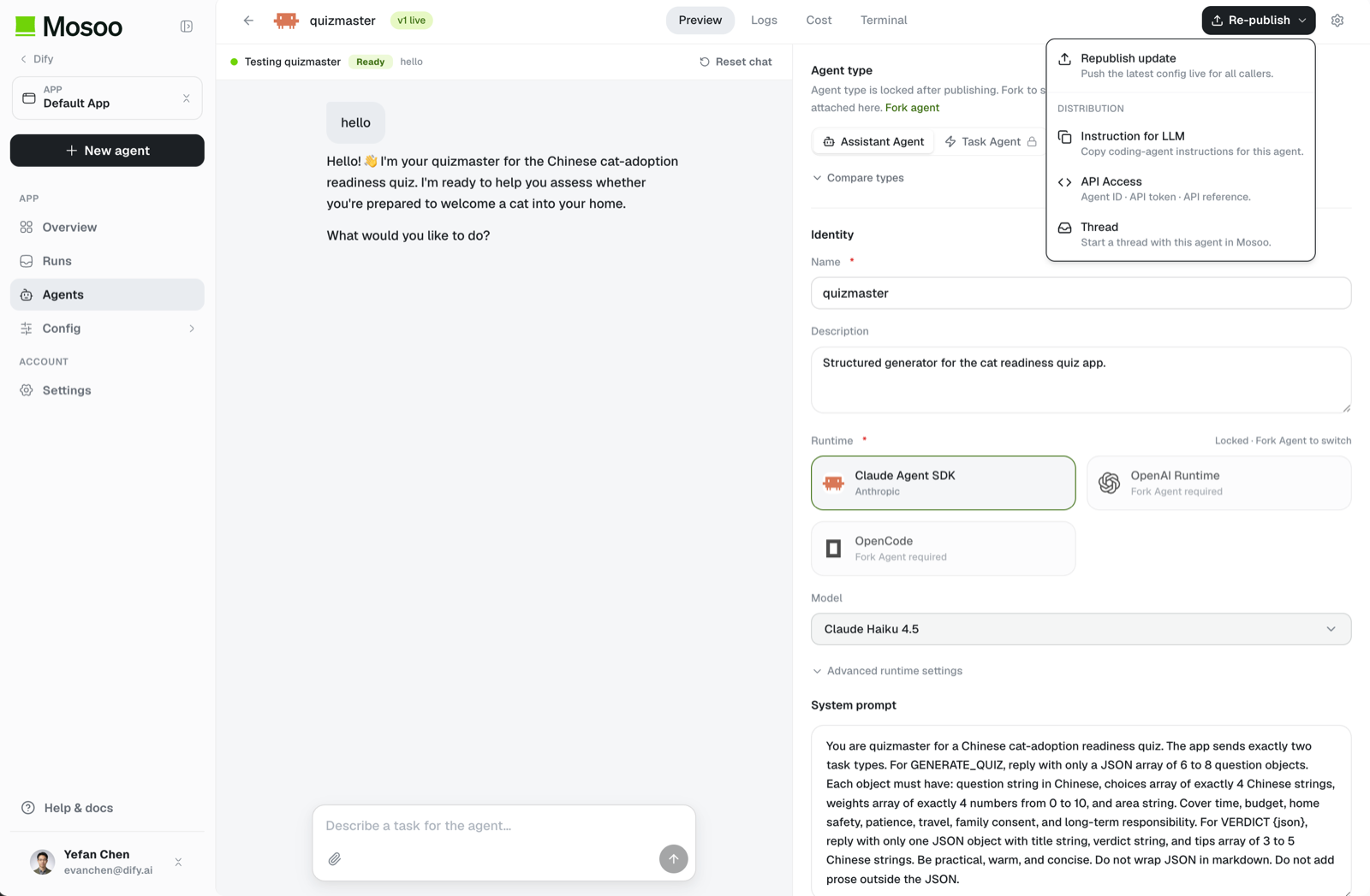
Paste the instruction into Claude Code or Codex and let it wire the API into your backend. You still review authentication, data access, and the user experience like any production integration.
Local agents proved the value of giving models a real runtime. The next step is not a larger model call. It is a managed agent task that your product can start, observe, and continue through an API.
Try it at cloud.mosoo.ai, or read the code on GitHub: langgenius/mosoo.